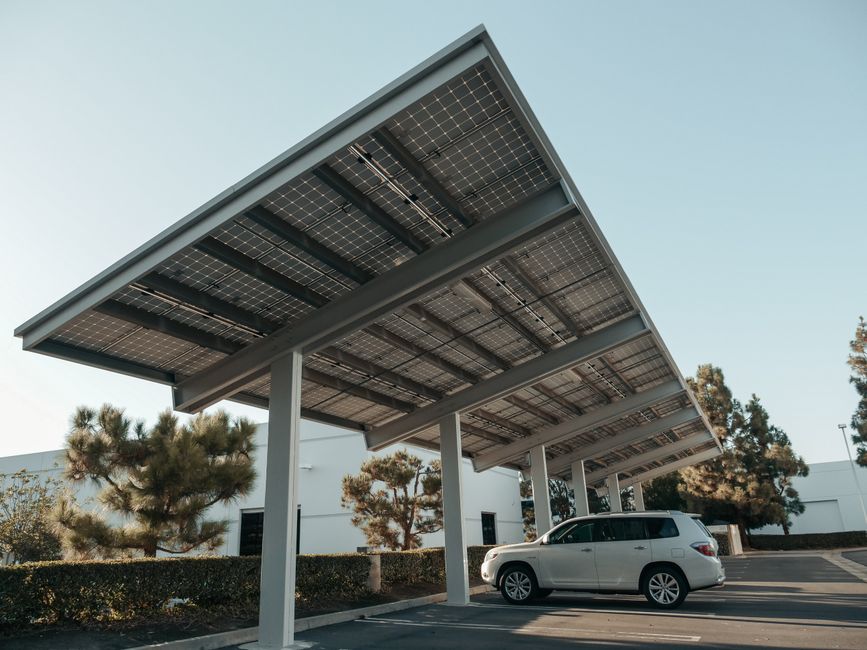
Solar panel shading analysis evaluates how trees, buildings, and structures obstruct sunlight and reduce energy output. Shade from obstacles can decrease panel efficiency by 10–25% or more, making pre-installation shading assessments critical for accurate solar cost and savings estimates.
How Trees and Buildings Cast Shadows on Solar Panels
Shadow patterns on a rooftop are never static. The sun moves across the sky in an arc that shifts with the seasons, which means a tree that causes minimal shading in summer can cast deep shadows across your panels during winter months when the sun sits lower on the horizon.
Tree shading solar panels is one of the most common sources of energy loss in residential installations. Deciduous trees lose their leaves in winter, which partially mitigates the problem — but those same trees grow taller every year, meaning shading losses increase over the lifetime of your system. Evergreens present a year-round obstruction that requires careful mapping before panels are placed.
Building shadows solar output in urban and suburban neighborhoods even more aggressively. A two-story home next door can throw a shadow that stretches 30–40 feet depending on the time of year and your geographic latitude. Rooftop equipment like HVAC units, chimneys, and skylights on your own home also contribute to localized shading losses.
Understanding these patterns requires looking at the full solar path — from sunrise to sunset — across all 365 days of the year. Professional shading assessments use tools like the Solar Pathfinder, Solmetric SunEye, or software-based horizon analysis to map this complete picture before a single panel is mounted.
Quantifying Solar Panel Output Loss from Shading
The solar panel shade impact is more significant than most homeowners expect, and it’s not simply proportional. Traditional string inverter systems are particularly vulnerable because shading one panel in a series string reduces the output of every panel connected to it — a concept sometimes called the “Christmas lights effect.”
How Much Do Trees Reduce Solar Panel Output?
A single tree casting partial shade across two panels during peak afternoon hours can reduce system output by 15–30% depending on system architecture. According to the U.S. Department of Energy’s Solar Energy Technologies Office, shading losses are among the top factors that separate projected system performance from real-world output. In worst-case scenarios where shade covers a significant portion of the array during peak sun hours, output losses can exceed 50%.
Microinverters and DC power optimizers significantly reduce this vulnerability. By converting or optimizing power at the individual panel level, these technologies allow unshaded panels to perform at full capacity even when neighboring panels are partially shaded. The tradeoff is a higher upfront cost, which needs to factor into your solar panel shading analysis from the beginning.
What Percentage of Shade Makes Solar Panels Ineffective?
There is no universal cutoff, but most solar professionals use a threshold of 20% shading loss as the point where a rooftop section becomes marginally viable for solar installation. The National Renewable Energy Laboratory (NREL) uses shading derate factors in its PVWatts calculator, typically ranging from 1–3% for minimal shading to 10–30% or higher for heavily shaded sites. If your peak sun hours are already limited by your geography, even a 10% shading loss can push your payback period out by several years.
The financial math is straightforward: if your system is designed to produce 10,000 kWh per year but shading losses reduce that to 7,500 kWh, you’re losing the equivalent of roughly 2,500 kWh of electricity value annually. At an average rate of $0.13–$0.16 per kWh, that’s $325–$400 in lost savings every single year.
Use our solar savings calculator to model how different shading loss percentages affect your long-term return on investment before committing to an installation quote.
Conducting a Shading Analysis Before Installation
A proper shading analysis before installation is the most important step a homeowner can take to protect their solar investment. Here’s how the process works and what to look for in a quality assessment.
Step 1 — Horizon mapping: A full 360-degree horizon survey identifies every obstruction that could block sunlight at any point during the year. This includes trees, neighboring buildings, utility poles, and rooftop equipment. The survey is conducted from the plane of the proposed array, not from ground level.
Step 2 — Solar access scoring: Many professionals calculate a Solar Access Value (SAV) or use shading factor tools to produce a percentage score reflecting how much available solar radiation actually reaches the roof surface. A score above 80% is generally considered viable; below 70% raises serious concerns about system economics.
Step 3 — Seasonal simulation: Shading patterns in December look nothing like shading patterns in June. A complete analysis models obstruction angles across solstices and equinoxes to capture the full range of seasonal variation, particularly important for evaluating building shadows solar output through winter months.
Step 4 — Panel layout optimization: Based on shading data, the installer adjusts panel placement to avoid the most problematic shading zones. In some cases, this means using a split array on two roof faces or eliminating certain sections of the roof entirely from the installation plan.
For homeowners in tree-heavy neighborhoods, it’s also worth consulting a certified arborist about tree trimming or removal costs, which can sometimes be offset by the increased solar production and factored into the total project ROI calculation.
How to Use the Solar Panel Shading Calculator
Estimating shading losses manually takes expertise and specialized equipment. Our solar panel output calculator lets you input shading loss percentages alongside your roof orientation, tilt angle, and local utility rates to generate a realistic production estimate for your specific conditions.
To get the most accurate results, gather the following before using the tool:
- Your roof’s primary orientation (azimuth angle)
- An estimated shading loss percentage (use 5% for minimal shade, 15% for moderate, 25%+ for heavy)
- Your current monthly electricity usage in kWh
- Your utility’s current retail rate per kWh
Once you have baseline output numbers, plug them into our solar payback period calculator to see how shading losses extend your break-even timeline compared to a fully unshaded installation.
Frequently Asked Questions
Can solar panels work at all in partial shade?
Yes, solar panels generate electricity in partial shade, but output is meaningfully reduced. Systems using microinverters or power optimizers perform significantly better in shaded conditions than traditional string inverter setups. Partial shade is not necessarily a dealbreaker, but it must be accurately modeled to set realistic production and savings expectations.
How often should a shading analysis be updated?
Shading conditions change over time as trees grow and neighboring structures are built or modified. A shading analysis conducted at installation may not reflect conditions five or ten years later. Homeowners should revisit shading assessments every 3–5 years, particularly if nearby trees have grown significantly or new construction has appeared in the vicinity.