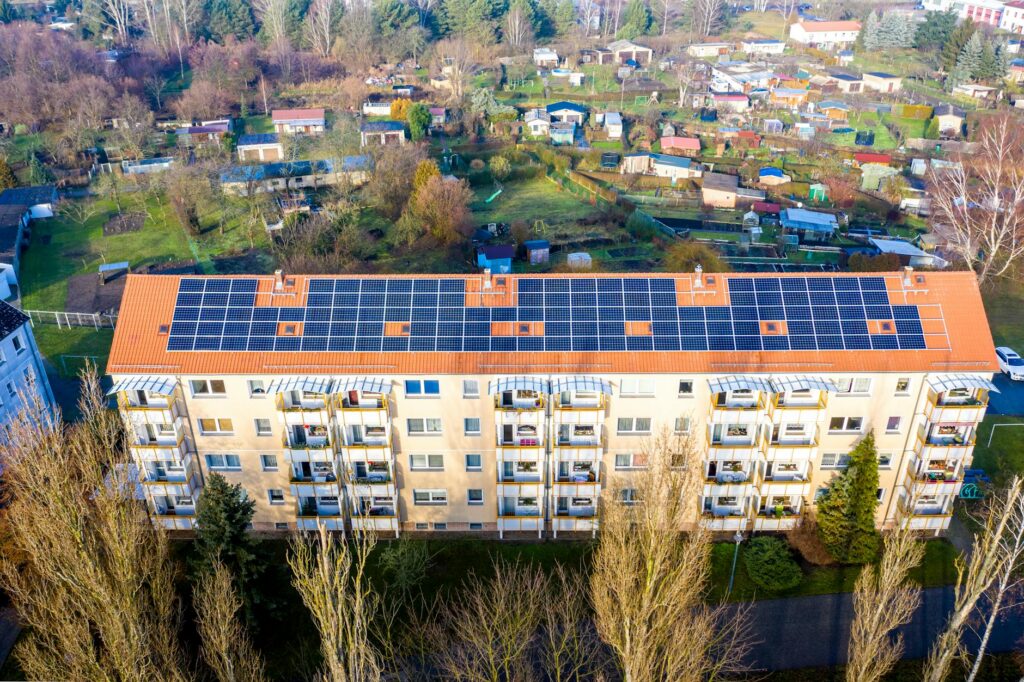
Commercial and residential solar systems serve different purposes and operate under distinct frameworks. While both harness the sun’s energy to generate electricity, they differ significantly in scale, cost, incentives, installation complexity, and ROI timelines. Understanding these differences helps property owners and business managers make informed decisions about solar adoption.
System Size and Energy Production Capacity
The most obvious difference between commercial and residential solar is scale. Residential systems typically range from 3 to 10 kilowatts (kW), designed to offset a household’s electricity consumption of around 10,000-15,000 kWh annually. Most homeowners install systems on their roofs with 15-25 panels.
Commercial systems, by contrast, often exceed 50 kW and can stretch into megawatts for large facilities. A mid-sized office building might install a 100-500 kW system, while warehouses and manufacturing plants can deploy systems exceeding 1 megawatt. This larger capacity directly correlates with the substantially higher energy demands of commercial operations. A commercial bakery running ovens 16 hours daily, for example, requires far more solar generation than a home using basic appliances.
The physical footprint reflects this difference too. Residential systems utilize rooftop space efficiently, while commercial installations often span entire roofs, parking structures, ground-mounted arrays, or canopies. This additional space availability makes commercial solar more flexible in design and placement.
Cost Structure and Financial Investment
Residential solar systems typically cost between $15,000 and $25,000 before incentives, translating to roughly $2.50 to $3.50 per watt. A 6 kW system costs less per watt than a 3 kW system due to economies of scale, but the overall investment remains modest for most homeowners.
Commercial solar involves substantially larger upfront investments—often ranging from $100,000 to over $1 million depending on system size and configuration. However, commercial installations benefit from significant cost advantages per watt, typically $1.50 to $2.50 per watt. This lower per-watt cost reflects bulk purchasing power, simpler installation processes on commercial roofs, and reduced soft costs like permitting as a percentage of total project cost.
Financing options also differ. Homeowners primarily use personal loans, home equity lines of credit, or dedicated solar financing. Commercial entities often access commercial loans, power purchase agreements (PPAs), or lease structures. Many businesses can immediately deduct solar installation costs under Section 179 depreciation rules, creating additional tax advantages beyond federal investment tax credits.
Incentives, Tax Credits, and ROI Timeline
Both residential and commercial systems benefit from the federal Investment Tax Credit (ITC), currently at 30%. However, their applications differ meaningfully. Residential homeowners receive a direct tax credit reducing their tax liability. Since most homeowners’ tax liability doesn’t exceed their credit amount, they can typically use the full 30% immediately.
Commercial entities often benefit more substantially from the ITC because they generate sufficient tax liability to capture the full benefit immediately. Additionally, businesses can accelerate depreciation through bonus depreciation rules, creating years of tax deductions even after claiming the ITC. This stacking of incentives dramatically improves commercial solar ROI.
Return on investment timelines reflect these differences. Residential solar typically pays for itself in 6-12 years, after which homeowners enjoy 15-20 years of nearly free electricity. Residential systems generate modest savings of $800-1,500 annually, though this varies by location and electricity rates.
Commercial systems often achieve ROI in 4-7 years, with some reaching payback in just 3 years, depending on local electricity rates and incentive stacking. Large commercial users in high-rate areas like California or Massachusetts can save $15,000-$50,000+ annually, creating compelling ROI calculations that attract business investment.
Installation, Maintenance, and Technical Differences
Residential installations are relatively straightforward—installers work on pitched roofs, navigate residential electrical systems, and coordinate with homeowners. Projects typically complete within 1-3 days of actual installation after permitting and inspections.
Commercial installations involve more complexity. Large commercial roofs must undergo structural engineering assessments to confirm they can support solar arrays. Commercial facilities often require three-phase electrical systems rather than single-phase residential systems, necessitating specialized equipment and expertise. Installations might take weeks to months, especially on operational facilities where work must avoid disrupting business activities.
Maintenance requirements are similar—both systems need occasional cleaning and monitoring—but commercial systems benefit from professional maintenance contracts and monitoring services that many businesses include in their solar agreements. Residential owners typically handle maintenance independently or through optional service plans.
How to Use the Solar Calculator
Whether you’re evaluating residential or commercial solar, estimating your specific costs and savings requires understanding your energy consumption and local conditions. Use our solar cost calculator to input your location, roof type, average monthly electricity bills, and system preferences. The calculator provides personalized estimates for installation costs, federal tax credits, estimated annual savings, and payback period—helping you compare residential and commercial solar scenarios side-by-side.
Frequently Asked Questions
Can residential solar systems be as cost-effective as commercial systems?
Residential solar offers strong ROI for homeowners, typically paying for itself in 6-12 years. However, commercial systems generally achieve faster payback periods (3-7 years) due to higher electricity consumption, stacked tax incentives, and depreciation benefits available to businesses. Residential effectiveness depends heavily on your location’s electricity rates—homeowners in areas with high rates like Hawaii or California see faster payback than those in lower-rate regions.
Do residential and commercial systems require different equipment?
The core technology is identical—both use photovoltaic panels, inverters, and wiring. However, commercial systems often require specialized equipment like three-phase inverters, more sophisticated monitoring systems, and heavier-duty hardware to handle higher voltage and current loads. Residential systems use simpler single-phase inverters appropriate for lower power demands. Both integrate seamlessly with utility grids through appropriate interconnection equipment.
Are there different incentives available for commercial versus residential solar?
Both qualify for the 30% federal ITC. The key difference is that commercial users can also claim accelerated depreciation, Section 179 deductions, and state-level commercial solar incentives in many jurisdictions. Some states offer rebates or performance-based incentives favoring commercial installations. Homeowners should check for state and local residential incentives, which vary by location but are typically less generous than commercial programs.