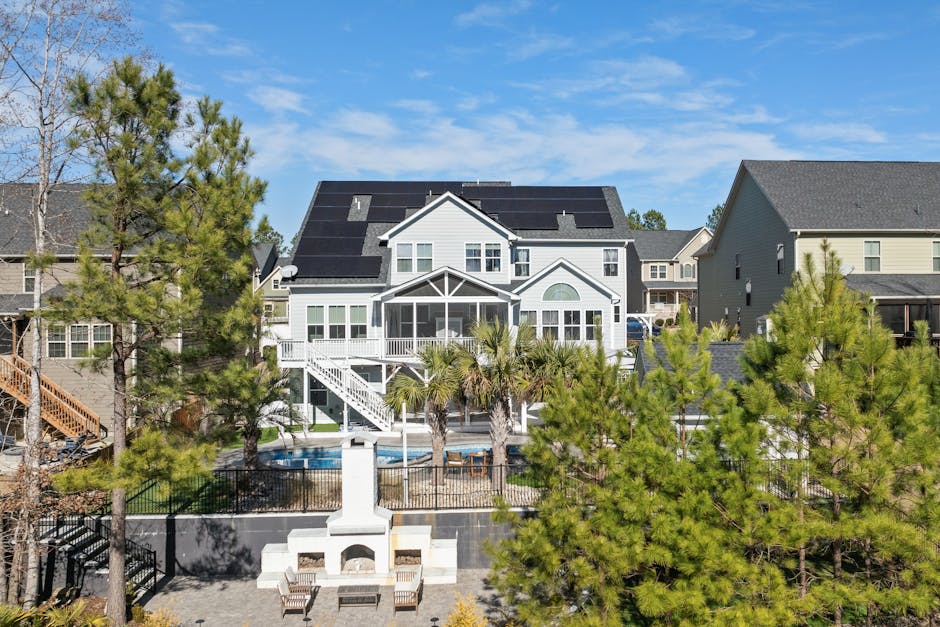
South Carolina stands out in the 2026 solar market for one critical reason: its state tax credit survived the repeal of the federal ITC. While the federal 30% residential solar tax credit was eliminated in early 2026, South Carolina homeowners still benefit from a 25% state credit, a full property tax exemption, and a 6% sales tax exemption — making SC one of the strongest remaining incentive markets in the Southeast.
No address or signup required.
Solar Cost Estimator
Your Solar Estimate
Ready to go solar? Get Free Solar Quotes →
South Carolina Solar Quick Facts (2026)
- Average Cost Per Watt: $2.50–$2.55 (installed)
- Typical 8 kW System Cost: $20,000–$20,400 before incentives
- Average Electricity Rate: 13–14 cents/kWh
- Peak Sun Hours: 5.0–5.2 hours/day
- Federal Tax Credit: Repealed in 2026 — no longer available for new installations
- SC State Tax Credit: 25% of system cost, up to $3,500/year, lifetime max $35,000 (no expiration)
- Property Tax Exemption: Full exemption on added solar value — your tax bill does not increase
- Sales Tax Exemption: 6% exemption on all solar equipment
South Carolina Solar Incentives in 2026
Despite the loss of the federal 30% credit, South Carolina maintains one of the strongest state-level incentive stacks in the region:
South Carolina State Solar Tax Credit (25%)
South Carolina allows homeowners to claim 25% of the total installed solar cost as a direct credit against their state income tax liability. The credit is capped at $3,500 per year, with a lifetime maximum of $35,000 — or 50% of your annual state tax liability, whichever is less. There is no expiration date on this program.
For a typical $20,000 system, this yields a $5,000 total credit: $3,500 applied in year one and $1,500 the following year. Unlike deductions, this is a dollar-for-dollar reduction in your SC tax bill — one of the most powerful remaining solar incentives in the U.S. after the federal repeal.
South Carolina Sales Tax Exemption
South Carolina exempts solar energy equipment from the state 6% sales tax. On a $20,000 installation, that is approximately $1,200 in immediate savings at the point of purchase — no application, no waiting.
South Carolina Property Tax Exemption
South Carolina provides a full property tax exemption on the added value of residential solar installations. Your home appraisal will rise with a solar system, but your annual property tax assessment will not — saving potentially $200–$400 per year depending on your local millage rate.
Net Metering
South Carolina requires investor-owned utilities — including Duke Energy and Dominion Energy Carolinas — to offer net metering. Excess solar generation sent to the grid is credited to your monthly bill, further reducing your effective electricity cost. Verify current credit rates with your specific utility, as compensation rates vary.
South Carolina Solar Savings & Payback Period
With 5.0–5.2 peak sun hours per day and above-average electricity rates of 13–14 cents/kWh, South Carolina is one of the strongest solar economics markets in the Southeast. An 8 kW system typically generates 11,500–13,500 kWh per year, producing $1,495–$1,890 in annual electricity savings.
After applying the 25% state tax credit ($5,000 over two tax years) and the 6% sales tax exemption (~$1,200), the effective net cost of a $20,000 system drops to approximately $13,800. At $1,600 per year in average savings, payback runs 8–10 years — among the best remaining timelines in any state that no longer has the federal ITC.
South Carolina Solar Costs by City
Solar installation prices vary across South Carolina by labor market and coastal permitting requirements:
- Columbia: $19,000–$22,000 for 8 kW — Duke Energy territory, strong installer competition
- Charleston: $20,000–$24,000 for 8 kW — coastal wind-resistance requirements add cost
- Greenville: $18,500–$21,500 for 8 kW — competitive upstate installer market
- Myrtle Beach: $19,000–$22,500 for 8 kW — coastal permitting and hurricane ratings add cost
- Spartanburg: $18,000–$21,000 for 8 kW — lower labor costs than coastal markets
Coastal properties require wind-rated mounting hardware, which adds $500–$1,500 to installation costs compared to interior markets. The good news: coastal locations also tend to have excellent sun exposure year-round.
Is Solar Worth It in South Carolina After the Federal Credit Repeal?
South Carolina is arguably one of the best states for residential solar in 2026, even after the federal ITC repeal. The 25% state tax credit alone delivers dollar-for-dollar tax relief on one-quarter of your system cost — a benefit that was additive to the federal 30% before 2026, and now stands as the primary incentive. Combined with strong sun, above-average electricity rates, and zero property tax impact, the economics remain compelling:
- Payback period: 8–10 years (among the shortest in any non-ITC state)
- 25-year lifetime savings: $25,000–$40,000 for most 8 kW systems
- Home value increase: Full property tax exemption means zero annual cost for the added value
Ready to go solar in South Carolina? Calculate your exact South Carolina solar cost or get free South Carolina solar quotes.
South Carolina Solar FAQs
How much do solar panels cost in South Carolina in 2026?
Solar panels cost $2.50–$2.55 per watt installed in South Carolina in 2026. A typical 8 kW residential system costs $20,000–$20,400 before incentives. After the 25% SC state tax credit ($5,000 applied over two tax years) and the 6% sales tax exemption (~$1,200), effective net cost drops to approximately $13,800–$14,200 for most homeowners.
What is South Carolina’s solar tax credit in 2026?
South Carolina offers a 25% state income tax credit on the total installed cost of a solar system. The credit is capped at $3,500 per year with a lifetime maximum of $35,000 (or 50% of your annual state tax liability). For a $20,000 system, you receive a total $5,000 credit: $3,500 in year one and $1,500 in year two. There is no expiration date on this program.
What is the solar payback period in South Carolina?
The solar payback period in South Carolina is approximately 8–10 years in 2026 after applying the 25% state tax credit and sales tax exemption. With 5.0–5.2 peak sun hours daily and electricity rates of 13–14 cents/kWh, most 8 kW systems generate $1,495–$1,890 in annual savings. Over 25 years, total lifetime savings typically reach $25,000–$40,000.
Does South Carolina have a property tax exemption for solar?
Yes. South Carolina provides a full property tax exemption on the added value of solar installations. Even though adding solar increases your home’s appraised value, your annual property tax assessment does not change. This saves most homeowners $200–$400 per year in property taxes over the life of the system.
Is South Carolina a good state for solar after the federal tax credit repeal?
Yes, South Carolina is one of the best remaining solar states after the federal ITC repeal. The 25% state tax credit provides up to $5,000 in direct credits for a $20,000 system, combined with a property tax exemption and 6% sales tax exemption. With strong sun exposure and above-average electricity rates, SC homeowners can still achieve 8–10 year payback periods and $25,000–$40,000 in lifetime savings.