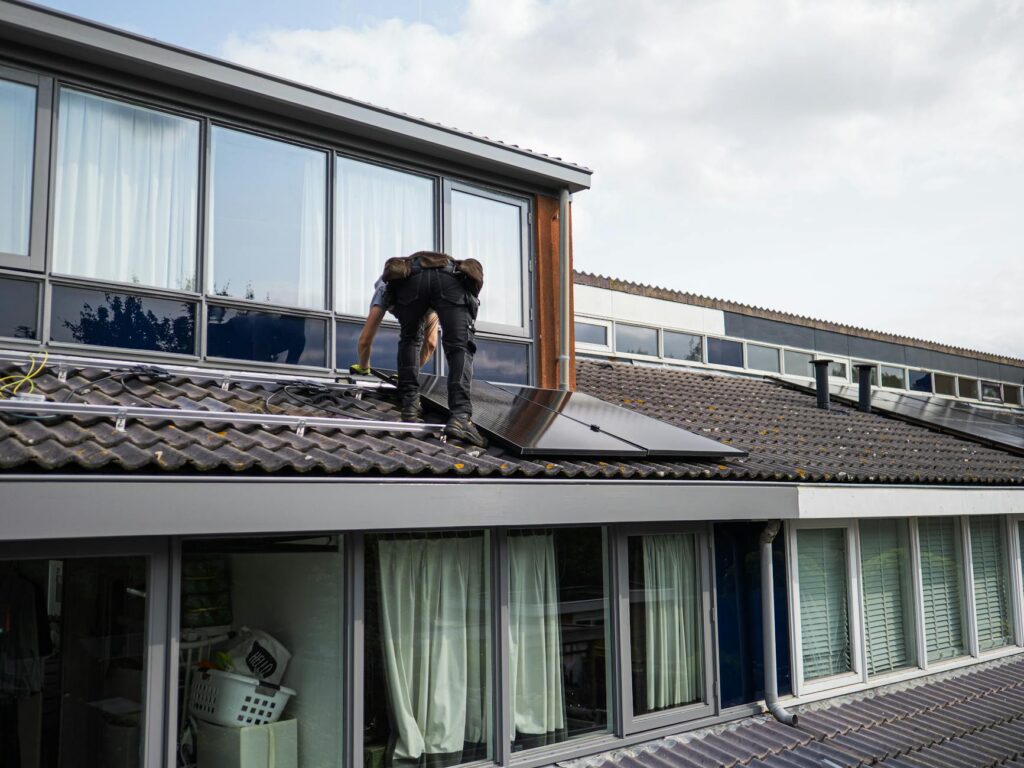
The inverter you choose directly impacts your solar system’s efficiency, lifespan, and return on investment. Microinverters and string inverters represent the two dominant technologies today, each with distinct advantages depending on your roof layout, shading conditions, and budget. Understanding the real differences helps you make an informed decision that maximizes your payback period and long-term savings.
How Microinverters and String Inverters Work
A string inverter converts DC power from all your solar panels (typically 8-12 panels wired in series) into AC power at one central location. It’s the traditional approach, installed in a single box on your garage wall or ground mount. The entire string operates at the performance level of your weakest panel—if one panel is shaded, all panels in that string slow down proportionally.
A microinverter converts DC to AC power at each individual panel, typically mounted directly behind the panel or on the roof. Each panel operates independently, so shading on one panel only affects that panel’s output. According to data from the National Renewable Energy Laboratory (NREL), microinverter systems can produce 5-25% more energy in partially shaded scenarios compared to string inverter systems.
The practical impact: if your roof has tree shade, roof obstructions, or panels facing multiple directions, microinverters likely deliver better performance. If your roof has consistent, unobstructed sun exposure, a string inverter works just as well at lower cost.
Cost Comparison and Real ROI Impact
String inverters typically cost $2,000-$3,500 installed, while microinverter systems run $3,500-$6,000 for the same panel count. That’s a premium of $1,500-$2,500 upfront. However, your actual ROI depends on your specific shading conditions and local electricity rates.
Example in a sunny climate (minimal shading): A 6 kW string inverter system in Phoenix, Arizona might cost $12,000 before incentives. With zero shading issues, the microinverter upgrade costs an extra $2,000 but generates only 2-3% more energy annually. At Arizona’s average utility rate of $0.13/kWh, that’s roughly $50-$75 extra electricity per year—a payback on the premium that takes 27-40 years. String inverter wins financially.
Example in a partially shaded home: The same 6 kW system in Portland, Oregon (more cloud cover, potential tree shade) might see a 12% performance boost from microinverters. At Oregon’s average rate of $0.12/kWh, that’s approximately $220 extra annual savings. The 5-year payback on the $2,000 premium improves significantly, and over a 25-year system lifespan, you recover the upfront cost plus gain $3,500 in additional savings.
Reliability, Warranty, and Long-Term Considerations
String inverters have been the industry standard for 30+ years. They’re proven, mature technology with well-established warranty coverage—typically 10-15 years, with some manufacturers offering 20-year extended warranties. Replacement cost if failure occurs after warranty is $2,500-$4,000.
Microinverters are newer but increasingly reliable. Most come with 25-year warranties that match your panel warranties, which is a major advantage. If one microinverter fails, only that panel loses output—you don’t lose your entire system. However, replacing multiple microinverters later is more labor-intensive (and costly per unit) than swapping a single central inverter.
Real consideration: Both systems are expected to function 25+ years. Modern string inverters from reputable manufacturers (SMA, Fronius, Enphase, SolarEdge) rarely fail within their warranty period. Microinverter failure rates are comparable. The reliability difference is negligible for quality products—the choice comes down to shading performance and warranty length.
Monitoring, Optimization, and Scalability
String inverters provide whole-system monitoring—you see your total output in real time. Some advanced string inverters (like SolarEdge) include DC optimizers that function similarly to microinverters, giving you panel-level monitoring without the full microinverter cost.
Microinverters give you granular panel-level data. You can see exactly which panels underperform due to shading or soiling (dust), which helps with system maintenance decisions. This data is valuable if you’re performance-obsessed or managing a commercial portfolio.
For scalability: adding panels later is cheaper with string inverters (just add a new string). Microinverter systems scale more seamlessly since each new panel installs independently, though you’ll pay the per-panel microinverter cost.
How to Use the Solar ROI Calculator
The best way to compare microinverter and string inverter payback periods for your specific home is to model both scenarios with local utility rates, incentives, and shading data. Use the Solar ROI Calculator to input your annual electricity usage, local rates, and expected system size, then compare 25-year savings under both inverter types. The calculator accounts for federal tax credits, state incentives, and depreciation to show your true financial outcome.
FAQ: Solar Microinverters vs String Inverters
Q: Do microinverters work in cloudy climates?
A: Yes. Microinverters don’t require constant sunshine—they work on cloudy days just like string inverters. The advantage of microinverters in cloudy regions is that they reduce the impact of partial shading from clouds, trees, or roof obstructions. In consistently cloudy areas with zero shading, string inverters and microinverters perform nearly identically.
Q: Can I upgrade from a string inverter to microinverters later?
A: Technically yes, but it’s expensive. You’d need to install a microinverter behind each panel, which requires roof work and electrical rewiring. Most homeowners choose their inverter type upfront. If you’re unsure about future expansion or shading changes, consult a solar installer about your specific roof before committing.
Q: Which inverter type qualifies for the federal tax credit?
A: Both. The 30% federal Investment Tax Credit (ITC) applies to the entire solar system, including inverters of either type. Your total eligible system cost is reduced by 30%, regardless of inverter choice. Some states offer additional rebates that may apply differently based on system design, so verify with your local utility.
- Enphase IQ Microinverter System — Direct product match – Enphase is the leading microinverter manufacturer and readers comparing microinverter options would benefit from seeing real products and specifications
- SolarEdge String Inverter with Power Optimizer — Complementary string inverter option – provides readers with the opposing technology to make informed comparisons between both inverter types discussed in the post
- Solar Monitoring System and Performance Meter — Natural add-on – readers deciding between inverter types would benefit from monitoring tools to track efficiency and performance differences between the two systems